
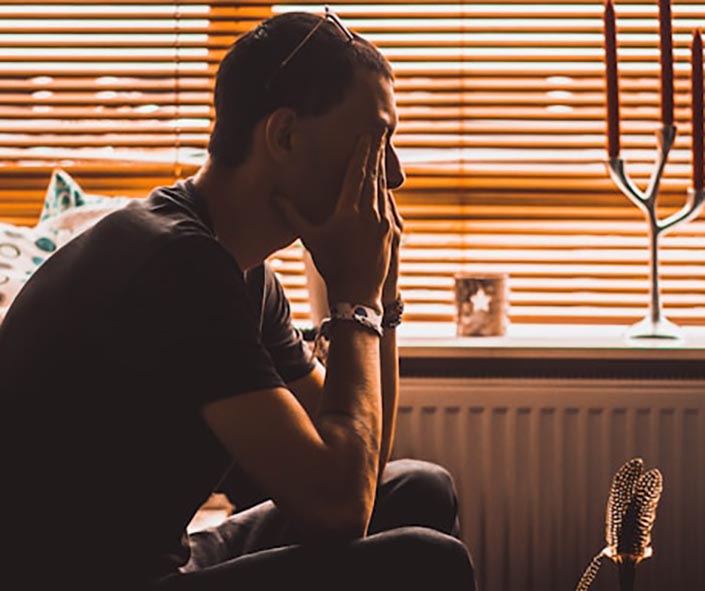
Childhood Domestic Violence and the Weight of Hopelessness
By the CDV Team
Part of the 10 Lies Series, exploring the lie of hopelessness that childhood domestic violence teaches, and the truth of accomplishment that replaces it.
Why does everything feel so overwhelming? Not one specific thing. Everything. The emails. The decisions. The dishes. The idea of making a plan for next week when you can barely get through today.
Everyone around you seems to manage. They make grocery lists and return phone calls and show up on time and you’re doing all the same things, but for you it feels like moving through something thick. Like the effort it takes to be a functioning person is three times what it costs anyone else.
You’re not lazy. You’re not weak. You’re carrying a weight that nobody can see, and it was placed on you a very long time ago, in a house where you learned something devastating: that no matter what you did, you couldn’t change the outcome.
If you feel hopeless about life, or lost, or so discouraged that even thinking about the future feels exhausting, the feeling may not be coming from the present at all. It may be coming from a childhood where trying didn’t work.
When “Fine” Takes All the Energy You Have
People ask how you’re doing and you say fine. What you mean is: you got out of bed, you made it here, and that’s all you’ve got.
The exhaustion that comes from growing up with domestic violence isn’t the exhaustion of doing too much. It’s the exhaustion of carrying too much. You’re not just navigating adult life. You’re navigating it while running a background program that most people don’t have: the constant calculation of emotional safety, the monitoring of other people’s moods, the bracing for disruptions that may never come.
By the time you’ve handled the invisible work, there’s very little left for the visible kind. The emails pile up. The laundry sits. The phone calls go unreturned. Not because you don’t care, but because you’ve spent your daily capacity on something nobody else can see.
From the outside, it looks like you’re struggling with basic life. From the inside, you’re performing a feat of endurance that would exhaust anyone who understood what it actually takes.
Learned Helplessness: When Childhood Taught You That Trying Doesn’t Matter
There’s a concept in psychology called learned helplessness. It describes what happens when someone is repeatedly exposed to a situation they cannot control: eventually, they stop trying to control anything at all. Even when the situation changes, even when control becomes possible, the person has already concluded that effort is pointless.
Children in homes with domestic violence are prime candidates for learned helplessness. They can’t stop the violence. They can’t fix the adults. They can’t make the house safe. They try everything a child can try: being good, being quiet, being invisible, being perfect. None of it works. The violence continues regardless of what they do. (This is closely connected to the guilt that makes children believe everything is their fault: they take responsibility, and when responsibility doesn’t change anything, hopelessness follows.)
The lesson the brain takes from this is not “this specific situation is beyond my control.” The lesson is broader and more damaging: “My actions don’t change outcomes. Effort is futile.”
That lesson follows you into adulthood. It shows up as the feeling that nothing ever gets better. That no matter what you do, the result will be the same. That the future is just the present, repeating. It’s not depression, exactly, though it can look like it and coexist with it. It’s a deeply held belief, formed in childhood, that your efforts don’t matter.
They do. They always did. But a child in an uncontrollable situation had no way to know that.
The Difference Between Tired and Hopeless
Tired has a remedy. You rest, and you feel better.
Hopelessness doesn’t respond to rest. You can sleep for twelve hours and wake up with the same weight on your chest. You can take a vacation and spend the whole time feeling like you’re watching someone else’s life from behind glass. You can have a perfectly good day and still feel, underneath all of it, that none of it will last.
That’s because hopelessness isn’t fatigue. It’s a conclusion the brain reached a long time ago and never revised. The conclusion is: this is as good as it gets. Don’t expect more. Don’t hope for more. Hoping only sets you up for disappointment, and there’s been enough of that. (This same protective mechanism is what drives the sadness that spirals from small things: a nervous system that learned to cap expectations before they can be disappointed.)
The conclusion was reasonable when it was made. A child in a home with domestic violence who learned not to hope was protecting themselves from the pain of repeated disappointment. But that child is now an adult, and the conclusion is no longer accurate. It’s just old.
Why Normal Life Feels Harder for You Than It “Should”
You’ve probably told yourself some version of this: other people handle this just fine. Why can’t you?
The answer is that other people aren’t starting from where you’re starting. They didn’t spend their childhood running a threat detection system. They didn’t learn that calm is temporary and chaos is the default. They didn’t grow up with the ambient weight of knowing that the people who were supposed to protect them were also the source of fear. Research on the long-term effects of childhood domestic violence shows that these early experiences fundamentally change the brain’s stress response and capacity for regulation.
You are doing everything they’re doing, plus carrying something they’re not. That’s not a level playing field. And comparing your capacity to theirs without accounting for the weight you’re carrying is a comparison that will always make you feel like you’re failing.
You’re not failing. You’re functioning under a load that most people have never had to carry.
More than 40 million adults in the United States grew up witnessing domestic violence. Many of them feel this same disparity: the gap between how much effort they’re expending and how little it seems to produce. The gap isn’t evidence of inadequacy. It’s evidence of an uneven starting line.
The Accomplishment You’ve Already Forgotten: You Made It Through
In the book Invincible, hopelessness is called one of the ten lies that childhood domestic violence teaches. It’s the lie that says nothing will ever change, that the weight is permanent, that the best you can hope for is getting through the day.
The truth that replaces it: you are accomplished. Not in the resume sense, though that may also be true. In the survival sense. You made it through something that would have broken many people. You navigated a childhood that required more resilience, more alertness, and more emotional labor than most adults will ever face. And you’re here. Reading this. Still trying to understand yourself and grow. That’s not nothing. That’s enormous.
Hopelessness tells you that nothing you do matters. Your existence disproves that. You did the hardest thing, getting through a childhood with domestic violence, and you did it without any of the resources, perspective, or freedom you have now. If you could navigate that as a child, with a child’s brain and a child’s body and no choice about any of it, imagine what’s possible now that you actually get to choose.
Finding Forward When You Can’t See the Path
You don’t have to see the whole path. You don’t have to feel hopeful right now. You don’t have to transform your outlook by the end of this article.
You just have to notice one thing: the hopelessness has a source. It didn’t come from nowhere. It came from a specific set of experiences in a specific house during a specific period of your life. And anything with a source can be understood. And anything that can be understood can, eventually, be changed.
If reading this is the only thing you do today, that’s enough. If taking the assessment below is the next step, that’s enough. If saving this page and coming back to it later is what feels manageable, that’s enough. You don’t have to overhaul your life. You just have to stop believing the lie that says you can’t.
Take the free 1-minute CDV assessment → Start here
The assessment is private, takes about one minute, and is a starting point. There’s no pass or fail. You can also explore what childhood domestic violence is, download free support worksheets, or read stories from others who’ve been where you are.
Hopelessness Doesn’t Stand Alone
If the overwhelm resonates, you may also recognize other patterns. Many people who grew up with domestic violence also carry a sadness that spirals from the smallest trigger, the belief that they are fundamentally not good enough, or a deep isolation that persists even in close relationships. These are all expressions of the same experience. Understanding one helps see the others.
If you’re ready to take the next step, the free CDV assessment takes about one minute. If you’d rather keep reading, explore the long-term effects of CDV or download the free support worksheets. And if someone came to mind while reading this, share this page with them.
If you’re experiencing persistent feelings of hopelessness or thoughts of self-harm, please reach out to a mental health professional or contact the 988 Suicide and Crisis Lifeline by calling or texting 988. You deserve support, and help is available.